

1. What We Already See but Rarely Explain
Laws apply long after their authors are gone.
Contracts are executed without the parties present.
Technical systems continue to operate when no one remembers who designed them.
These facts are not disputed.
They are familiar to the point of triviality.
The difficulty is not whether operational meaning persists.
The difficulty is how that persistence remains possible once the originating minds are absent.
Most discussions stop at description.
They note that texts endure, that records remain, and that systems continue to operate.
They treat this endurance as a background condition.
What is usually missing is an explanation of the structural consequences of this persistence.
Seeing that meaning continues to act is easy.
Seeing what must replace the regulatory role of bodies is not.
The issue is therefore not evident.
It is explanatory.
2. Why the Intuitive Explanation Used to Work
The most common explanation treats meaning as a form of psychological continuity.
Meaning lives in minds.
Symbols merely point to what someone understands.
Within this frame, persistence looks derivative.
Texts matter because people read them.
Rules matter because people remember them.
Coordination happens because shared understanding is maintained.
This explanation was coherent under specific conditions.
Meaning circulated locally.
Interpretation and response were closely timed.
Misunderstandings produced immediate feedback.
If someone misread a signal, the cost was felt quickly.
If a norm failed, its failure was visible.
Biological correction mechanisms remained in the loop.
Under those conditions, it was reasonable to treat symbols as secondary.
The body handled error correction.
Understanding and consequence stayed coupled.
The explanation fails when those conditions disappear.
When interpretation is delayed.
When authors are absent.
When enforcement is mediated by artifacts rather than bodies.
At that point, appealing to individual understanding no longer explains coordination.
It describes an origin story, not an operating system.
The persistence of operational meaning requires something else.
The intuitive model does not account for it.
3. The Substrate Break
Operational meaning becomes visible when symbols continue to produce consequences after their authors and original interpreters are absent.
This requires a precise use of the term externalization.
Externalization does not mean that meaning leaves minds in a metaphysical sense.
It means that meaning is carried by artifacts that remain actionable even in the absence of the minds that generated them.
A written law can be applied when its authors are dead.
A contract can be enforced when its signatories are absent.
A technical protocol can coordinate action when no one remembers its design rationale.
In all these cases, meaning persists as operational meaning.
It is not stored as an inner experience.
It is stabilized as a structure that triggers actions and consequences under rules.
The break introduced here is therefore not ontological.
It is regulatory.
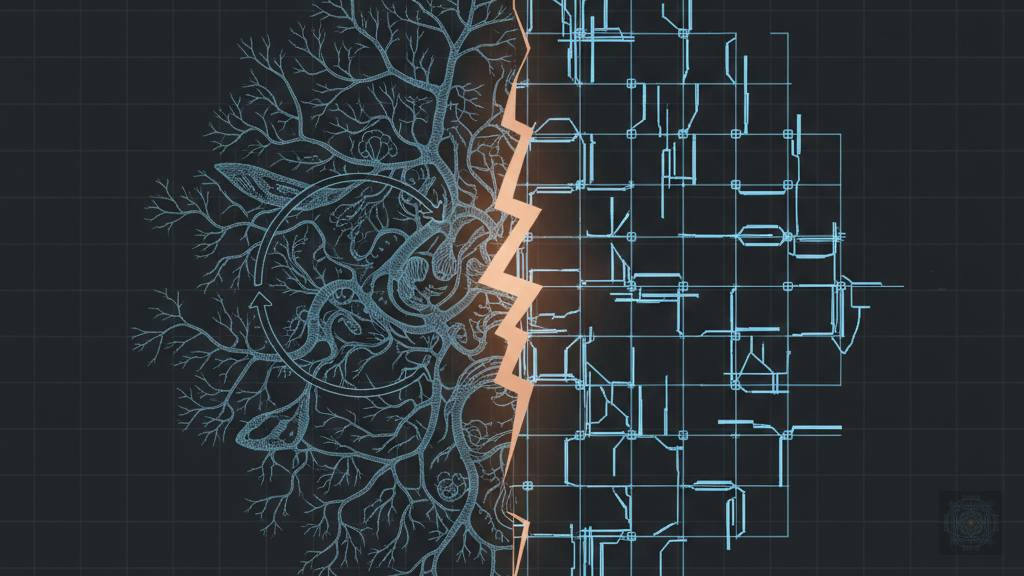
When meaning is embodied, it is regulated by biological mechanisms.
When meaning is carried by persistent symbols, those mechanisms no longer apply.
This is the substrate break.
Meaning shifts from biological coupling to artifact-mediated persistence.
What changes is not what meaning is, but how error, correction, and constraint can occur.
Once this shift is in place, the original regulatory loop cannot be assumed to hold.
Any explanation that relies on it silently fails.
4. What Biological Regulation Supplied
Before externalization, meaning operated under biological constraint.
Interpretation and consequence were tightly coupled.
Errors produced immediate feedback.
Misalignment had a cost.
Biological regulation provided four properties simultaneously.
Immediate feedback
Action was followed by rapid sensory consequence.
Embodied error
Mistakes were felt, not merely noted.
Survival cost
Persistent error reduced viability.
Automatic correction
No external system was required to enforce adjustment.
These properties did not depend on reflection or agreement.
They followed from embodiment.
As long as meaning circulated within this loop, correction did not need to be designed.
It happened by default.
Once meaning moved to persistent symbols, this default disappeared.
The body was no longer in the loop.
What remains is meaning that still acts, but no longer corrects itself.
5. What Persistent Symbols Do Not Provide
Persistent symbols continue to operate without sensing the effects they produce.
They do not perceive outcomes.
They do not register failure.
They do not distinguish success from breakdown.
A symbol does not feel pain.
It does not incur cost.
It does not risk extinction.
Because of this, no intrinsic correction loop exists at the level of the symbol itself.
A rule can be misapplied indefinitely.
A record can propagate an error without resistance.
A specification can remain authoritative while being wrong.
The symbol persists regardless.
This is not a defect.
It is a property of the substrate.
Biological systems correct because they must.
Symbolic systems persist because they can.
Once meaning is carried by persistent artifacts, correction is no longer automatic.
If correction occurs, it must come from elsewhere.
6. Drift as a Structural Effect
When correction is delayed, reinterpretation accumulates.
This effect can be named drift.
Drift is reinterpretation without timely correction.
It does not require confusion or bad faith.
It follows from how meaning is distributed and stabilized.
Persistent symbols are interpreted across time.
They are read by different agents.
They are applied in contexts far removed from their origin.
Feedback arrives late, if at all.
Consequences are displaced.
Error is no longer localized.
As a result, meaning can change while remaining operational.
This is not error by accident.
It is error by structure.
Nothing in the symbolic substrate stops reinterpretation from accumulating.
Nothing forces convergence.
Nothing restores alignment by default.
Drift is therefore not an anomaly.
It is a predictable outcome once biological regulation is removed.
Without additional structures, it cannot be avoided.
7. Accumulation as a Structural Effect
Once meaning is stabilized in persistent symbols, it begins to accumulate.
Accumulation occurs when semantic load exceeds individual comprehension.
Rules are added to rules.
Records are layered on records.
Precedents multiply faster than they can be integrated.
Each addition is locally intelligible.
The total is not.
This is not a failure of attention or education.
It is a consequence of persistence.
Symbols do not decay when they become difficult to understand.
They remain valid, enforceable, and operative.
As a result, no individual can serve as a complete regulator of meaning.
Understanding becomes partial by necessity.
Oversight fragments.
Correction becomes indirect.
Accumulation, therefore, marks a second structural consequence of the substrate break.
Meaning remains operational while escaping the limits of individual cognition.
8. Why Understanding Cannot Restore Regulation
It is tempting to treat accumulation as a knowledge problem.
The natural response is to demand better understanding.
This response fails structurally.
More understanding does not restore lost feedback loops.
Insight does not recreate immediacy.
Knowledge does not impose cost.
An individual may fully grasp a rule yet remain unable to correct its operation.
They may detect an error and lack a mechanism to prevent its propagation.
They may understand consequences without being able to enforce change.
Cognition explains.
It does not regulate.
Biological regulation worked because error was felt.
Symbolic systems do not feel.
Once meaning is externalized, correction can no longer be cognitive alone.
It must be structural.
This is not a limit of intelligence.
It is a limit imposed by the substrate itself.
9. When Drift Is Limited
Drift is not inevitable in every case.
It can be constrained, though not eliminated.
There are systems in which reinterpretation does not freely accumulate.
Protocols remain stable.
Rules converge rather than diverge.
This happens only under specific structural conditions.
The decisive factors are not shared understanding or good faith.
They are external regulators.
Three features matter.
Explicit rules
Interpretation space is narrowed in advance.
Ambiguity is reduced structurally rather than resolved psychologically.
Non-bypassable enforcement
Consequences follow application regardless of intent.
Compliance does not depend on agreement.
Persistent records
Past decisions remain accessible and binding.
Correction does not rely on memory or recollection.
These features do not restore biological regulation.
They do not reintroduce pain, survival cost, or embodiment.
They replace lost feedback with designed constraint.
Where drift is limited, it is limited by structure.
Not by cognition.
Not by intention.
10. A Structural Parallel from Engineered Systems
A close parallel appears in engineered systems that lose natural feedback.
When a system no longer self-corrects through physical response, instability follows.
Noise accumulates.
Deviation persists.
Stability is restored only by adding control structures.
Sensors are introduced.
Thresholds are defined.
Actuators enforce correction.
The key point is not the technology.
It is the logic.
Once natural feedback is gone, control must be designed.
It does not emerge spontaneously.
It does not follow from a better understanding of the system.
Operational meaning follows the same constraint.
When biological regulation disappears, stability requires architecture.
Rules, enforcement, and records play the role that sensation and consequence once played.
Constraint is therefore not a cultural preference.
It is a structural necessity imposed by the substrate.
Without it, drift and accumulation are not failures.
They are the expected outcome.
11. What Remains Invisible Without the Structure
When the substrate break is not recognized, familiar failures are misdiagnosed.
Drift is explained as cultural confusion.
Disagreement is blamed on interpretation, ideology, or bad faith.
Accumulation is described as complexity.
Overload is treated as an unfortunate side effect of growth.
Institutions are then read as historical contingencies.
They appear as cultural inventions, power grabs, or bureaucratic excess.
These explanations are not incoherent.
They are incomplete.
They describe surface phenomena while missing the constraint that produces them.
Without the structural distinction, persistence is seen but not explained.
Regulation is assumed rather than accounted for.
Correction is expected where no correction mechanism exists.
What fails in these accounts is not evidence.
What fails is the explanatory frame.
12. What This Makes Legible
The central distinction is now visible.
Meaning was once regulated by bodies.
It is now carried by persistent symbols.
This shift breaks the original correction loop.
Nothing in the symbolic substrate replaces it by default.
Disagreement therefore persists not because facts are missing,
but because different explanatory frames are applied to the same phenomena.
One frame assumes biological regulation.
The other begins from symbolic persistence.
The contribution of this analysis is not empirical.
It does not introduce new facts.
It is structural.
It explains why, once operational meaning leaves bodies,
correction must be rebuilt rather than assumed.
After this point, the persistence of disagreement is no longer puzzling.
It is expected.