

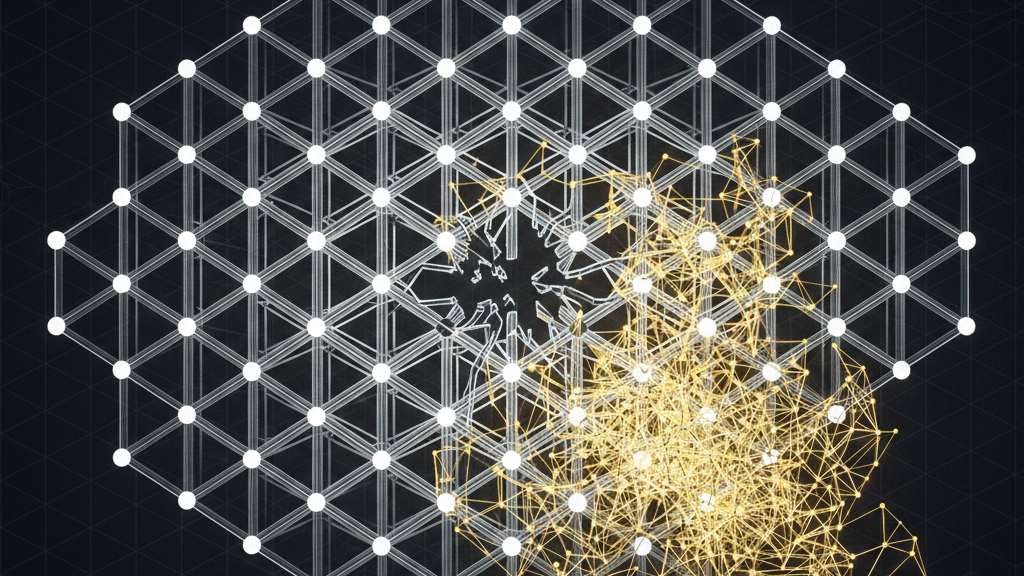
I. When Meaning Leaves the Body
Not all consequences of externalization appear at the moment it occurs.
The Point of Origin article ended with a break.
Meaning was no longer enacted inside biological coupling.
It was placed outside the body.
Preserved.
Repeatable.
That break is often described as an extension.
A memory aid.
A tool for coordination.
Those descriptions stay on the surface.
Externalization does more than preserve what was already there.
It changes what meaning can be.
Once meaning is externalized, it no longer lives or dies with the act that produced it.
It can survive the failure of the situation it addressed.
It can persist without correction.
This is not a quantitative change.
It is not “more meaning.”
It is a new condition.
Externalized meaning can now fail without disappearing.
It can remain present while being wrong.
It can be reused despite no longer fitting reality.
That possibility did not exist before.
In biological coupling, failure is immediate.
A bad action collapses the loop.
The organism pays the cost directly.
There is no distance between error and consequence.
No residue.
No record.
Externalization introduces distance.
Meaning is no longer audited by survival alone.
It can drift away from the conditions that once constrained it.
This is the threshold.
Not accumulation.
Not abstraction.
Not institutions.
Error.
Once meaning can be wrong and remain present, everything that follows becomes necessary.
II. Sense-Making Without Error
Before symbols, there is no interpretation.
A biological system does not stand apart from its environment and ask what something means.
It acts.
The environment responds.
Viability is updated in real time.
This is sense-making.
Sense-making is not representational.
It does not traffic in claims.
It does not hold propositions about the world.
An organism does not misread a symbol.
It either maintains coupling or loses it.
If the action fits, the loop continues.
If it does not, the loop collapses.
That collapse is not recorded.
It is enacted.
There is no memory of being wrong.
There is only consequence.
Because of this, error cannot accumulate.
A failed action does not persist as a reusable structure.
It does not wait to be repeated.
It does not spread.
Disagreement is impossible at this level.
There are no alternative interpretations to contest.
There is only successful regulation or breakdown.
Sense-making is audited continuously by reality itself.
The audit cannot be postponed.
It cannot be negotiated.
This is why biological systems cannot lie.
They have no slack.
They operate inside a closed loop where failure terminates behavior rather than coexisting with it.
Sense-making does not permit error to remain present.
It permits only adaptation or death.
Meaning, as something that can be wrong and still endure, does not yet exist here.
That requires distance.
III. Symbolic Detachment and the Birth of Error
Symbols interrupt immediacy.
Once a mark, word, rule, or diagram exists outside the act that produced it, it is no longer bound to the original situation.
It does not need to be reenacted to remain present.
It does not require ongoing feedback to persist.
A symbol can wait.
It can be carried into a new context without resistance.
It can be applied by someone who did not witness its origin.
It can be reused long after the conditions that made it sensible have vanished.
This is the decisive shift.
Correctness is no longer enforced by survival.
A symbol does not fail simply because it no longer fits reality.
It can now be:
Applied where it does not belong
Interpreted in ways never intended
Preserved even after repeated failure
None of this breaks the symbol.
The symbol continues to exist.
It remains available.
It remains authoritative to someone.
This is not a defect in the system.
It is what makes meaning possible at all.
Meaning requires separation.
Separation creates slack.
Slack creates the possibility of being wrong without disappearing.
A symbol that could not be misapplied would not be meaningful.
It would be a reflex.
Error is not an anomaly introduced by carelessness.
It is the structural price paid for abstraction.
Once symbols are detached from immediate feedback, error is born.
IV. Error Is Not a Bug
A familiar reflex appears at this point.
Error is treated as contamination.
As noise introduced by carelessness.
As a flaw to be engineered away.
That reflex misreads the structure.
Error is not something that happens to symbolic systems.
It is something symbolic systems make possible.
If a symbol could only be used correctly, it would not be a symbol.
It would be a trigger.
Behavior does not misapply itself.
Reflexes do not drift.
Coupling either holds or collapses.
Symbols are different.
They operate at a distance from the conditions that once constrained them.
They must be interpretable across contexts.
They must survive reuse.
That survivability requires slack.
And slack allows misapplication.
A rule that cannot be broken is not a rule.
A statement that cannot be false is not a claim.
A symbol that cannot fail is not meaningful.
Attempts to eliminate error at the symbolic level do not restore correctness.
They collapse meaning back into behavior.
This is why zero-error fantasies recur.
And why they always fail.
To remove error is to remove abstraction.
To remove abstraction is to remove meaning.
Error is not degradation.
It is the structural cost of operating beyond immediate feedback.
Meaning exists only where something can go wrong and remain present.
That is not a defect to be patched.
It is the condition that makes symbolic worlds possible at all.
V. Why Biology Cannot Lie
Lying requires distance.
A biological system does not assert claims about the world.
It enacts responses within it.
A bacterium cannot misrepresent the presence of nutrients.
A body cannot pretend oxygen is available.
When conditions change, behavior changes or collapses.
There is no intermediate layer where a false state can persist.
Biological systems may fail.
They may misfire.
They may die.
But they do not deceive.
Deception requires symbolic slack.
It requires a structure that can remain in place after it has stopped working.
A lie is not merely an incorrect response.
It is an incorrect representation that continues to function as if it were correct.
That continuity is impossible inside biological coupling.
Consequences arrive immediately.
Correction is enforced without delay.
Lies require persistence without audit.
They require symbols that outlive the consequences they misdescribe.
Only symbolic systems allow this.
Once meaning is externalized, a false claim can survive its failure.
It can be repeated.
Defended.
Passed on.
Biology has no such buffer.
This is why deception is not a biological phenomenon.
It is an institutional one.
Wherever lies are possible, symbols have already escaped immediate correction.
That escape is what makes institutions necessary.
VI. When Correction Can No Longer Come from Reality
Once error can persist, it does not remain isolated.
A symbol that survives its own failure becomes portable.
It can be repeated without revalidation.
Copied without reenactment.
Defended without reference to outcomes.
At this point, disagreement with reality is no longer self-correcting.
A false symbol does not dissolve when it fails.
It remains available.
It continues to circulate.
The environment no longer enforces correction directly.
Consequences arrive too late.
Or not at all.
Correction now requires intervention.
Not from nature.
From structure.
Someone must decide which symbols hold.
Which interpretations count.
Which uses are valid.
This is the first institutional pressure.
It is not coordination.
Coordination comes later.
It is not power.
Power exploits what already exists.
It is correction.
A need emerges for mechanisms that can:
detect persistent error
block reuse
override misapplication
restore alignment with reality
These mechanisms do not arise from intent or morality.
They arise from necessity.
Once symbols can be wrong and remain present, something must take responsibility for correction.
That something is not a mind.
It is not a belief.
It is an institution in embryo.
VII. From Error to Drift
Uncorrected error does not stay put.
Once a symbol survives its own failure, it becomes a foundation for further use.
Each reuse adds distance.
Each reinterpretation adds variation.
Error compounds.
Interpretations begin to stack.
Each one justified by the last.
Each one slightly further from the conditions that once constrained it.
Exceptions appear.
Then exceptions to the exceptions.
Local fixes that preserve continuity while weakening alignment.
Rationalizations follow.
The symbol still works somewhere.
It still produces outcomes.
It still feels coherent inside its own logic.
That internal coherence masks external drift.
This is not corruption in the moral sense.
No intent is required.
No deception is necessary.
Drift is what happens when symbolic systems preserve themselves faster than they are corrected.
The longer a symbol persists without enforced correction, the harder it becomes to remove.
It gains dependencies.
It acquires defenders.
It becomes embedded.
Structural inertia sets in.
At that point, error is no longer an anomaly.
It is part of the system’s normal operation.
This is why drift cannot be fixed by better intentions.
Or smarter agents.
Or increased vigilance.
Once symbolic error is allowed to accumulate, only structure can counteract it.
And if structure does not, drift becomes the default trajectory.
VIII. When Error Becomes Structural
Without this threshold, later claims lose their footing.
Drift appears accidental.
As if it were caused by carelessness or bad actors.
Accountability turns moral.
Something to be demanded rather than designed.
Institutions begin to look arbitrary.
Collections of rules without necessity.
All three misread the same thing.
Error is not introduced by misuse.
It is introduced by symbols themselves.
Once meaning can be wrong and remain present, correction can no longer be delegated to reality.
It must be organized.
Drift is not a failure of discipline.
It is what happens when persistent error is left unmanaged.
Accountability is not a virtue.
It is a response to symbolic slack.
Institutions are not optional overlays.
They are the structures that arise when meaning outlives its own correction.
Nothing in what follows depends on preference or design taste.
It follows from this single condition.
Once error is installed as a structural property,
correction becomes a structural problem.
And from that point on, every subsequent layer is no longer a choice.
IX. When Meaning Exceeds Human Scale
Once error can persist, it does not remain isolated.
A symbol that survives being wrong can be reused.
A symbol that can be reused can be repeated.
A symbol that is repeated begins to accumulate.
Accumulation is not excess.
It is the natural consequence of persistence.
Each retained symbol adds load.
Each added interpretation increases distance from the original situation.
Each exception thickens the structure.
At first, this load is manageable.
Individuals still track meanings through experience and memory.
Then a threshold is crossed.
No single person can hold the full symbolic field.
No one sees all dependencies.
No one feels all consequences.
Meaning has not disappeared.
It has exceeded human scale.
This is the next structural break.
Once symbols accumulate beyond individual grasp,
correction, interpretation, and continuity must be carried elsewhere.
That pressure does not produce better thinkers.
It produces new structures.
When meaning can be wrong and remain present, and symbols begin to pile up,
where does meaning go when no one can hold it anymore?
Reading Context
This article identifies persistent error as the necessary condition that distinguishes symbolic meaning from biological viability.
It does not argue for a position, forecast outcomes, or assign responsibility.
It examines the conditions under which a certain class of phenomena becomes possible once meaning is externalized, scaled, and no longer regulated by individual human cognition.
The analysis is second-order.
It addresses constraints, not preferences.
The ideas developed here are shaped by work in embodied and enactive cognition, systems theory, semiotics, engineering failure analysis, and institutional theory. These traditions are not treated as authorities, but as sources of constraints that remain valid once scale and persistence are taken seriously.
If the level at which this article operates feels unfamiliar, or if it seems to bypass debates that usually come first, the orientation article How to Read What Follows clarifies the ground on which the series is built.